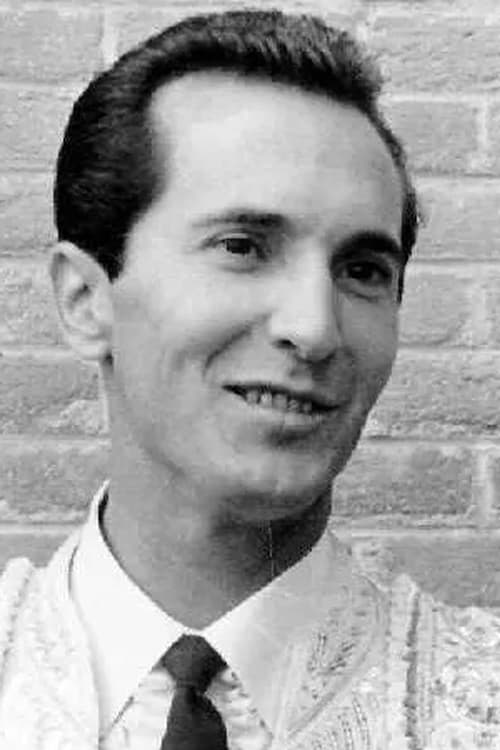
Luis Miguel Dominguín
Luis Miguel González Lucas (9 November 1926 – 8 May 1996), better known as Luis Miguel Dominguín, was a bullfighter from Spain and son of noteworthy bullfighter, Domingo Dominguín. Dominguín adopted his father's name to gain popularity. Dominguín made his first public appearance in the ring at the age of eleven. He became a matador in 1941. He enjoyed popularity during the 1940s and 1950s in Spain, Portugal, Colombia and other countries. He was on the card in Linares, Spain on 28 August 1947 when another legend, his rival Manolete, was fatally gored. Dominguín was also a socialite, having friends like Pablo Picasso and romances with the American actress Ava Gardner and the fashion model China Machado. In 1955, he married actress Lucia Bosé, who gave birth to his son Miguel Bosé, a Grammy-award winning singer. He also occasionally appeared in films, predominantly playing himself in cameo roles, in movies such as Around the World in 80 Days (1956), and Testament of Orpheus (1960). In 1959, he and his brother-in-law, Antonio Ordóñez, engaged in a bullfighting rivalry that was chronicled in Ernest Hemingway's posthumous book The Dangerous Summer,Ordóñez won. In 1971, at the age of 44, he returned to the bullring. That year he retired again, but returned to the ring in 1971, aged 45, when he attempted to fathom the sport's continuing allure. His comeback was at Las Palmas, the Canary Islands, when he wore the costume known as the "suit of lights," which had been designed for him by Picasso. He killed two bulls and won one ear, but was overshadowed by younger men - although the actress Deborah Kerr, who was in the crowd, insisted, "He is still the greatest bull-fighter." In 1953, Luis Miguel Dominguín met Miroslava Sternova in Cuba. Dominguín was half a year younger than she, so they parted as friends only until they met again in 1954, this time in the United States. She went on to work abroad in Spain to meet up with friends and Dominguín. After her return to Mexico, Sternova was found dead from an overdose. In one hand, she clutched three farewell notes; in the other, a photograph showing her with Dominguín and his mother. Rumor has it that she took her own life over the marriage of Dominguín and Bosè. By 1954, Dominguín's friendship with Ava Gardner was being widely reported. He considered her the most beautiful woman he had ever seen, but liked her more, he said, for her humor and understanding; he confessed himself unsure what he looked for in women. "Men fall in love with a woman's faults rather than her qualities," he mused. Ava had been previously associated with other bullfighters, though still married at the time to Frank Sinatra. The most spirited of them all was, no doubt, Luis Miguel Dominguín. However, the relationship was so passionate and stormy, and the fights between him and the diva had people talking. But also they had their tender moments. It is said that on their first night of lovemaking, he got out of bed and she asked: "Where are you going?". "To go tell!" replied the bullfighter. Years later, he admitted to a friend he made up that anecdote. ... Source: Article "Luis Miguel Dominguín" from Wikipedia in English, licensed under CC-BY-SA 3.0.
Luis Miguel González Lucas dit Luis Miguel Dominguín, né à Madrid (Espagne) le 9 novembre 1926, mort à San Roque (Espagne, province de Cadix) le 8 mai 1996, fils du matador «Domingo Dominguín», est un matador espagnol. Il toréa sous l’apodo («surnom») de «Dominguín», qu'utilisaient également son père, Domingo González Mateos, et ses frères, Domingo González Lucas et José González Lucas. Il est cependant le plus célèbre des «Dominguín» et celui que désigne généralement cet apodo. Considéré comme un des matadors les plus populaires des années 1940 et 1950, il débute à douze ans dans les arènes de Lisbonne (Portugal). Il prend l’alternative le 2 août 1944 à La Corogne, avec comme parrain Domingo Ortega. Torero flamboyant, d'une grande maîtrise qui pouvait passer pour de la froideur, il dut, pour gagner les faveurs du public, mettre en scène cet orgueil et cette rage qu'affectionnent les aficionados. C'est ainsi qu'en 1945, du lit où il se guérissait d'une cornada, il lança sur les ondes espagnoles un défi à «Manolete». Le duel, qui passionna les foules, fut interrompu par la mort de «Manolete». En 1958, son beau-frère, Antonio Ordóñez lui contestera cette suprématie et leur affrontement défraya à son tour la chronique. Il est immortalisé dans le reportage d'Ernest Hemingway, L'Eté dangereux. Il se termina par une série de graves blessures pour «Dominguin». Grand matador, il fut également grand séducteur: Ava Gardner, María Félix, Lana Turner, Rita Hayworth, Lauren Bacall notamment, comptent parmi ses innombrables conquêtes. En 1954, il épousa l’actrice Lucia Bosè dont il eut trois enfants, notamment le chanteur et acteur espagnol Miguel Bosé. Il divorça de Lucia Bosè en 1968, pour se remarier en 1987 avec Rosario Primo de Rivera. Il était particulièrement arrogant comme le soulignent François Zumbiehl, Michel Dieuzaide et José Arjona même avec ses amis les plus proches. De Pablo Picasso, il dit: «Picasso était passionné par les taureaux, ce qui ne veut pas dire qu'il était connaisseur. Tout est relatif évidemment. Comparé à un professionnel, il ne connaissait rien du taureau. Il ne savait pas distinguer, quand l'animal chargeait, si celui-ci donnait de la pointe ou restait court sur sa charge.» Pablo Picasso se rend souvent à Arles pour voir toréer Luis Miguel Dominguín dont il appréciait la compagnie comme celle de son épouse: l’actrice italienne Lucia Bosé. Le peintre lui dessina un costume de lumières et il dessina également le portrait du matador à l'encre de Chine. Pourtant, si les deux hommes sont très proches (Luis Miguel rédige pour Picasso un texte pour le livre de gravures Toros y toreros 1961), le matador refusera de faire avec le peintre une nouvelle Tauromachie à la manière de Pepe Hillo. «Picasso me proposait en échange de me faire cadeau de tous ses dessins originaux. Je lui ai répondu que je ne voulais pas faire une tauromachie. Quoi que je dise, si je suis honnête, il faudra que je confesse au bout du compte que ça ne sert à rien.» ... Source: Article "Luis Miguel Dominguín" de Wikipédia en français, soumis à la licence CC-BY-SA 3.0.
Acting (11)