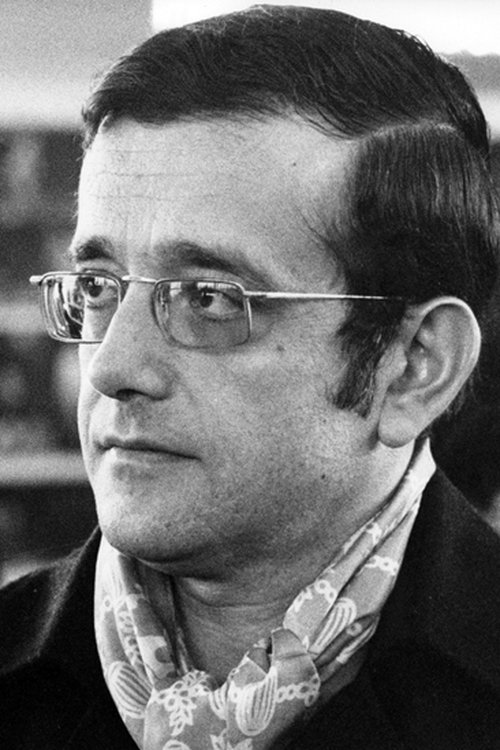
Marius Constant
Marius Constant (7 February 1925 – 15 May 2004) was a Romanian-born French composer and conductor. Although known in the classical world primarily for his ballet scores, his most widely known music was the iconic guitar theme for The Twilight Zone American television series. Constant was born in Bucharest, Romania, and studied piano and composition at the Bucharest Conservatory, receiving the George Enescu Award in 1944. In 1946, he moved to Paris, studying at the Conservatoire de Paris with Olivier Messiaen, Tony Aubin, Arthur Honegger and Nadia Boulanger. His compositions earned several prizes. From 1950 on, he was increasingly involved with electronic music and joined Pierre Schaeffer's Groupe de Recherche de Musique Concrète. From 1956 to 1966, Constant conducted at the Ballets de Paris, then directed by Roland Petit. To this period belong the numerous ballet scores for Petit and Maurice Béjart, namely: Haut-voltage (1956), Contrepointe (1958), Cyrano de Bergerac (1959), Éloge de la folie (1966) and Paradis perdu (1967). For the 1957 Aix-en-Provence Festival, he wrote a piano concerto, but won wider recognition for the premiere, conducted by Leonard Bernstein, of 24 Préludes pour Orchestre (1958). Turner (1961) was a tone poem inspired by the English painter William Turner. In the late 1950s, Constant was commissioned by Lud Gluskin of CBS to create a number of short pieces for the CBS stock music library that could be used in CBS radio and TV shows. The unusual, sometimes discordant nature of Constant's work meant that the pieces were seldom heard or used. In 1960, Gluskin was asked to find a new theme for the main title and end credits of the CBS television series The Twilight Zone, then entering its second season, to replace the original one by Bernard Herrmann. New pieces submitted by Herrmann, Jerry Goldsmith, Leith Stevens, and others, were considered unsuitable. In desperation, Gluskin edited together two pieces by Constant ("Étrange No. 3", a series of repeated four-note phrases on electric guitar, and "Milieu No. 2", an odd pattern of guitar notes, bongo drums, brass and flutes). The resulting theme quickly became iconic, and is easily Constant's most well-known work. Constant himself was apparently unaware for some years that his music was being used as The Twilight Zone theme. Because the music was part of a "work made for hire" agreement with CBS, Constant derived no ongoing income from it. In 1963, Constant founded the pioneering Ensemble Ars Nova. In 1970, he took over the musical direction of the ORTF; from 1973 to 1978 he directed at the Paris Opera, and in 1988 and 1989 was Professor of Orchestration at the Paris Conservatory. Besides these appointments, he taught at Stanford University and in Hilversum. Later ballets include Septentrion (1975), Nana (1976) and L'ange bleu (1985). La tragédie de Carmen (1981), his adaptation of Bizet's opera for director Peter Brook, was an international success. ... Source: Article "Marius Constant" from Wikipedia in English, licensed under CC-BY-SA 3.0.
Marius Constant est un compositeur et chef d'orchestre français d'origine roumaine, né le 7 février 1925 à Bucarest et mort le 15 mai 2004 à Paris. Marius Constant suit des études de piano et de composition au conservatoire de Bucarest jusqu'en 1944 auprès de Dinu Lipatti, Georges Enesco et Constantin Silvestri. En 1946, il arrive en France, où il devient l'élève de Tony Aubin, d'Olivier Messiaen, de Nadia Boulanger et d'Arthur Honegger au Conservatoire de Paris. À partir de 1950, s'intéressant à la musique électronique, il devient membre du Groupe de recherche de musique concrète de Pierre Schaeffer. Il est cofondateur et directeur de France Musique (1954-1969). De 1956 à 1966, il est directeur musical des Ballets de Paris de Roland Petit, il compose plusieurs ballets pour Roland Petit et Maurice Béjart (Haut-voltage (1956), Contrepointe (1958), Cyrano de Bergerac (1959), Éloge de la folie (1966) et Paradis perdu (1967). Pour le festival d'Aix-en-Provence de 1957, il écrit un concerto pour piano. Leonard Bernstein crée 24 Préludes pour orchestre (1958). En 1963, il crée l'ensemble Ars nova, consacré à la musique nouvelle. Il écrit d'autres ballets: Septentrion (1975), Nana (1976) et L'ange bleu (1985). La tragédie de Carmen (1981) est écrite en collaboration avec Peter Brook d'après l'opéra Carmen de Georges Bizet. Il enseigne l'orchestration et l'instrumentation au Conservatoire de Paris de 1978 à 1988. En 1982, il est membre de la commission Maurice Fleuret, chargée d'examiner le projet de construction de l'Opéra Bastille. Il enseigne à l'université Stanford et à Hilversum. Amateur de jazz passionné par le travail sur l'improvisation, il écrit Stress avec le pianiste de jazz Martial Solal. Le 9 décembre 1992, il est élu à l'Académie des beaux-arts au fauteuil d'Olivier Messiaen. Charles Chaynes lui succède en 2005 et prononce son éloge sous la Coupole en janvier 2007. Marius Constant est célèbre auprès du public américain pour avoir composé deux musiques qui servirent de thème principal au générique de début et de fin de la série la Quatrième Dimension produite par Rod Serling. D'abord destinées à la chaîne CBS, les deux courtes pièces intitulées Étrange 3 et Milieu 2, étaient composées pour un petit ensemble instrumental. Le directeur musical de la série Lud Gluskin les assembla pour en faire le générique d'ouverture en remplacement de la précédente musique composée par Bernard Herrmann. Le motif principal de quatre notes joué en boucle à la guitare électrique, est depuis connu en tant que Twilight Zone theme. Marius Constant meurt à Paris en 2004. Il est enterré au cimetière parisien d'Ivry (24e division). Source: Article "Marius Constant" de Wikipédia en français, soumis à la licence CC-BY-SA 3.0.