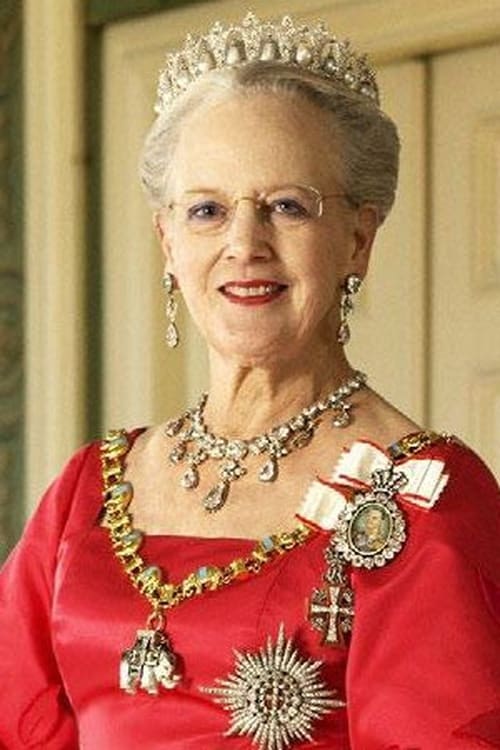
Queen Margrethe II of Denmark
Margrethe II (Margrethe Alexandrine Þórhildur Ingrid, born 16 April 1940) is Queen of Denmark. Having reigned as Denmark's monarch for over 50 years, she is the world's only current queen regnant and the longest-serving current female head of state. Born into the House of Glücksburg, a cadet branch of the House of Oldenburg, Margrethe is the eldest child of King Frederick IX and Queen Ingrid. She became heir presumptive to her father in 1953, when a constitutional amendment allowed women to inherit the throne. Margrethe succeeded her father upon his death on 14 January 1972. On her accession, she became the first female monarch of Denmark since Margrethe I, ruler of the Scandinavian kingdoms in 1376–1412 during the Kalmar Union. In 1967, she married Henri de Laborde de Monpezat, with whom she had two sons: Crown Prince Frederik and Prince Joachim. Margrethe is known for her strong archaeological passion and has participated in several excavations, including in Italy, Egypt, Denmark and South America. She shared this interest with her grandfather Gustaf VI Adolf of Sweden, with whom she spent some time unearthing artefacts near Etruria in 1962. As of 2023, Margrethe has, as sovereign, received 42 official state visits and she has undertaken 55 foreign state visits herself. She and the royal family have made several other foreign visits. Support for the monarchy in Denmark has been and remains consistently high at around 82%, as does Margrethe's personal popularity. Princess Margrethe was born 16 April 1940 at Frederik VIII's Palace, in her parents' residence at the Amalienborg palace complex, the principal residence of the Danish royal family in the district of Frederiksstaden in central Copenhagen. She was the first child of the Crown Prince and Crown Princess (later King Frederick IX and Queen Ingrid). Her father was the elder son of the then-reigning King Christian X, while her mother was the only daughter of the Crown Prince of Sweden (later King Gustaf VI Adolf). Her birth took place just one week after Nazi Germany's invasion of Denmark on 9 April 1940. Margrethe was baptised on 14 May in the Holmen Church in Copenhagen. The Princess's godparents were King Christian X (paternal grandfather); Hereditary Prince Knud (paternal uncle); Prince Axel (her paternal grandfather's first cousin); King Gustaf V of Sweden (maternal great-grandfather); Crown Prince Gustaf Adolf of Sweden (maternal grandfather); Prince Gustaf Adolf, Duke of Västerbotten (her maternal uncle); and Prince Arthur, Duke of Connaught and Strathearn (maternal great-grandfather). She was named Margrethe after her late maternal grandmother, Margaret, Crown Princess of Sweden, Alexandrine after her paternal grandmother, Queen Alexandrine, and Ingrid after her mother. Since her paternal grandfather was also the King of Iceland, she was given the Icelandic name Þórhildur. When Margrethe was four years old, in 1944, her younger sister Princess Benedikte was born. Princess Benedikte later married Prince Richard of Sayn-Wittgenstein-Berleburg and lives some of the time in Germany. Her second sister, Princess Anne-Marie, was born in 1946. Anne-Marie later married King Constantine II of the Hellenes and currently lives in Greece. ... Source: Article "Margrethe II" from Wikipedia in English, licensed under CC-BY-SA 3.0.
Margrethe Alexandrine Þórhildur Ingrid, Hendes Majestæt Dronningen, blev Danmarks Dronning i 1972. H.M. Dronning Margrethe 2. er født den 16. april 1940 på Amalienborg som datter af Frederik 9. (død 1972) og Dronning Ingrid, født Prinsesse af Sverige (død 2000).
Margrethe II, en français Marguerite II, née le 16 avril 1940 à Copenhague (Danemark), est la reine de Danemark depuis le 14 janvier 1972. Seconde femme à régner sur le pays (la première étant Marguerite Ire sept siècles plus tôt), la reine Margrethe II appartient à la maison de Schleswig-Holstein-Sonderbourg-Glücksbourg, une branche cadette de la maison d’Oldenbourg, dont les monarques danois sont issus depuis 1863. Depuis le décès d'Élisabeth II du Royaume-Uni le 8 septembre 2022, Margrethe II est la seule reine régnante du monde à la tête d'un pays indépendant. Elle est également le monarque ayant eu le règne personnel le plus long de l'histoire du Danemark (à ce jour 51 ans, 10 mois et 14 jours), dépassant le roi Christian IV. La future reine naît le 16 avril 1940 à la résidence de ses parents, le palais Frederik VIII, lui-même partie du complexe palatial d'Amalienborg, résidence principale de la famille royale de Danemark dans le quartier de Frederiksstaden au centre de Copenhague. Elle est le premier enfant du prince Frédéric, prince héritier du royaume de Danemark, et de son épouse la princesse Ingrid de Suède. La reine descend par son père des rois de Danemark et par sa mère des souverains suédois. Son grand-père maternel était le roi de Suède Gustave VI Adolphe et sa grand-mère maternelle Margaret de Connaught était la petite-fille de la reine Victoria. À ce titre, elle est apparentée à la plupart des membres des maisons royales d’Europe. Par sa mère Ingrid de Suède (de la dynastie Bernadotte), elle descend également de Joséphine de Beauharnais, impératrice des Français (les Bernadotte sont descendants de l’impératrice par sa petite-fille, la princesse Joséphine de Leuchtenberg, fille du prince Eugène et épouse d’Oscar Ier de Suède). À sa naissance, Margrethe est princesse d'Islande. En effet, son grand-père, le roi Christian X de Danemark est alors roi d'Islande. Elle porte comme deuxième prénom celui d’Alexandrine, sa grand-mère et dernière reine d’Islande, et comme troisième prénom celui de Þórhildur, son prénom islandais. En mai 1944, lors d'un référendum, les Islandais votent massivement pour l'abolition de la monarchie. L’Islande devient une république le 17 juin 1944 et Margrethe perd ce titre (à l'instar de la princesse Benedikte et du comte Ingolf). Née vers la fin du règne de son grand-père, Christian X, la princesse Margrethe n'a que sept ans lorsque son père monte sur le trône sous le nom de Frédéric IX en 1947. Elle étudie à l'école privée Zahle, d'où elle sort diplômée en 1959. Elle passe un an à la North Foreland Lodge, un pensionnat pour filles en Angleterre. Elle étudie ensuite l'archéologie au Girton College à Cambridge pendant l'année scolaire 1960-1961, la science politique à l'université Aarhus au Danemark entre 1961 et 1962, à la Sorbonne en 1963 et à la London School of Economics en 1965. La reine Margrethe parle couramment, outre le danois, l'allemand, l'anglais, le français, le suédois, et a des connaissances en féroïen. Elle épouse à Copenhague, le 10 juin 1967, le Français Henri de Laborde de Monpezat (1934-2018), avec qui elle aura deux fils: le prince héritier Frederik (1968) et le prince Joachim (1969). Elle est surnommée Daisy par sa famille et ses amis. ... Source: Article "Margrethe II" de Wikipédia en français, soumis à la licence CC-BY-SA 3.0.
Acting (60)