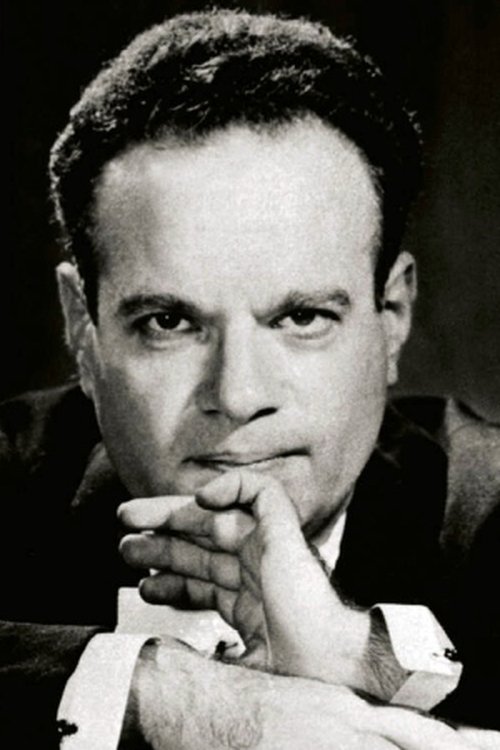
Julius Katchen
Julius Katchen (August 15, 1926 – April 29, 1969) was an American concert pianist, possibly best known for his recordings of Johannes Brahms's solo piano works. Katchen was born in Long Branch, New Jersey, and debuted at age 10, playing Mozart's D minor Concerto. Eugene Ormandy heard of his debut, and invited him to perform with the Philadelphia Orchestra in New York. He studied music with his maternal grandparents, Mr. and Mrs. Svet, immigrants from Europe who had taught at the Moscow and Warsaw conservatories, until he was 14. He attended Haverford College, completing a four-year degree in philosophy in three years, graduating first in his class in 1946. He went to Paris and was invited to represent the United States at the first International UNESCO Festival, where he played Beethoven's Emperor Concerto with the Orchestre National de la Radiodiffusion Française. He then toured Europe in the spring of 1947, playing recitals in Rome, Venice, Naples, Paris, London and Salzburg. After this, he decided to live in Paris permanently, saying "In France piano students come together constructively, and they can even become friends. They attend one another's concerts and applaud. In the US they go to hear a colleague play, but only in the hope of seeing him break his neck." He married Arlette Patoux, of Le Vesinet, France in 1956. In the late 1960s he recorded the Brahms trios for Decca with Josef Suk and János Starker. He also recorded the three violin sonatas with Suk, and the second cello sonata with Starker, but died before they could record the first sonata. In December 1968, Katchen played at a two-day show in London hosted by the Rolling Stones. Katchen played two works (one of them de Falla's Ritual Fire Dance). There is a DVD of the show called "The Rolling Stones Rock and Roll Circus". His last public appearance was with the London Symphony Orchestra on December 12, 1968, playing Ravel's Concerto for the Left Hand. He succumbed to cancer the next spring and died at the age of 42 at his home in Paris. Katchen and his wife Arlette were avid and astute collectors of netsuke; 195 pieces from their collection were sold at auction in 2005 and 2006 for £1.2 million ($2.2 million) (Sotheby's 2005 and 2006). A further 392 were sold at auction in 2016 and 2017 for £2.3 million ($3 million) (Bonhams 2016 and 2017), including Katchen's favorite piece (acquired after his death by Arlette) depicting a shaggy dog and pup by famed 18th century artist, Gechu, which brought the second highest price ever for a netsuke sold at auction. Katchen's six-disc set of Johannes Brahms's Works for Solo Piano (Decca) is highly regarded and often cited as one of the best available recordings of Brahms's piano music. In 2016, Decca released a 36-disc set of his complete recordings for the label. Source: Article "Julius Katchen" from Wikipedia in English, licensed under CC-BY-SA 3.0.
Julius Katchen est un pianiste américain né le 15 août 1926 à Long Branch (New Jersey, États-Unis) dans une famille d’origine juive émigrée de Russie, et mort le 29 avril 1969 à Paris (France). Julius Katchen commence l'apprentissage du piano à l'âge de cinq ans avec comme professeur sa grand-mère et étudie le solfège (contrepoint, harmonie et composition) et le violon avec son grand-père. Lors de sa première apparition publique, âgé de onze ans, il interprète le Concerto en ré mineur de Mozart avec l'orchestre de Philadelphie dirigé par Eugene Ormandy. Mais, dès 14 ans, son père l’oblige à reprendre des études plus conventionnelles: il obtient au «Haverford College» un diplôme en philosophie en 1946, date à laquelle il part pour Paris. C’est là que commence sa carrière internationale. En effet, il représente les États-Unis au premier Festival International de l’UNESCO, et y joue le Concerto pour piano nº 5 de Beethoven, «l’Empereur», accompagné par l’Orchestre National de la Radiodiffusion Française. Les concerts qu'il donne par la suite avec l'orchestre philharmonique de New York, et les orchestres symphoniques de Chicago et de Detroit confirment un début de carrière particulièrement brillant pour le jeune homme, qui décide à la fin des années 1950, de s’installer à Paris de façon permanente. C’est d’ailleurs dans cette ville qu’il décèdera d’un cancer le 29 avril 1969. Katchen aimait les programmes de concert «lourds»: en 1964, il donne en quatre soirées, à Londres, l’intégrale de l’œuvre pour piano de Brahms, qu’il a d’ailleurs enregistrée. Cette intégrale, considérée comme une référence, a été couronnée par un Grand Prix du Disque. Cependant on a pu reprocher à Katchen un jeu trop virtuose et pas assez incarné. Les critiques, tout en demandant «qu’il soit pardonné à tous ceux qui ont cru que cet homme avait quatre mains» (critique après un concert de Katchen), accusent le jeune homme de trop jouer avec ses mains, et pas assez avec son cœur. Katchen doit attendre ses dernières années pour obtenir des critiques plus laudatives, remarquant notamment, lors d’un concert consacré à Beethoven, «une sensibilité et une maturité étonnantes». Au-delà de la polémique, l’on constate que son répertoire s’étend plus loin qu’à la seule musique de Brahms. Katchen a enregistré Balakirev, Chopin, Liszt, Moussorgski, Prokofiev (le Concerto pour piano no 3), Ravel (les deux Concerti), mais aussi des compositeurs plus inattendus, comme Ned Rorem ou Ernő Dohnányi (Ernst von Dohnányi). Ses derniers enregistrements sont particulièrement brillants: il s’agit du Concerto pour la main gauche de Ravel, du Troisième concerto de Prokofiev, et de la Rhapsody in Blue de Gershwin, tous trois accompagnés du chef d’orchestre Istvan Kertesz, en novembre 1968. Katchen se savait gravement malade et nous lègue par ces trois enregistrements une sorte de testament musical. Les deux coffrets consacrés à Julius Katchen que Philips a publiés dans la collection «Grands pianistes du XXe siècle» donnent une bonne idée du style de cet interprète. Source: Article "Julius Katchen" de Wikipédia en français, soumis à la licence CC-BY-SA 3.0.