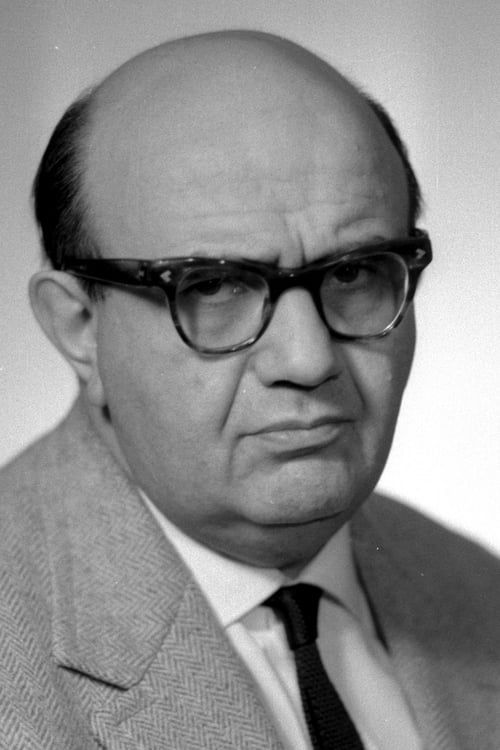
Aleksander Bardini
Aleksander Bardini (17 November 1913 – 30 July 1995) was a Polish actor, theatre director, artistic director, and educator.Born in Łódź to a Jewish family, after finishing high school in 1932 he studied violin and performed in the string quartet of the Jewish Music Association as well as in a Jewish cabaret. In 1935 he graduated from the Acting Department of PIST in Warsaw.He worked as an actor at the Municipal Theatre in Wilno (Vilnius) (1935–1936) and at the Polish Theatre in Warsaw (1938). In 1939 he joined the COP Travelling Theatre. For the 1939/40 season he was engaged by the Municipal Theatres in Lwów (Lviv), where he remained until 1941, working as both actor and director.During the German occupation he was initially in the Lviv ghetto, then hid in a private apartment. He returned to the Polish Dramatic Theatre in Lviv in 1944, where he served as a member of the artistic council, director, actor, and head of the acting studio until the company’s evacuation in August 1945.In the 1945/46 season he moved with the Lviv ensemble to the Municipal Theatre in Katowice. He had planned to join the Polish Army Theatre in Łódź for the 1946/47 season, but after the Kielce pogrom in July 1946 he decided to emigrate. Between 1946 and 1950 he lived in the USA, Canada, and West Germany, working manual labour and collaborating with the Jewish theatre in Munich.He returned to Poland in 1950. Until 1957 he worked as a director at the Polish Theatre in Warsaw. His greatest achievement of that period was the first postwar staging of Adam Mickiewicz’s Dziady (Forefathers’ Eve). He also occasionally appeared as an actor.In the 1957/58 season he was artistic consultant and director at the Stefan Jaracz Theatre in Łódź. From 1958 to 1960 he served as director and artistic manager of the Ateneum Theatre in Warsaw. Between 1960 and 1964 he was an actor and director at the Contemporary Theatre (Teatr Współczesny) in Warsaw, before returning to the Polish Theatre for the 1964/65 season. Afterwards he worked as a freelance director, staging productions in Poland and abroad.He also directed opera productions (he was a great lover and connoisseur of music). He frequently collaborated with Polish Television, hosting highly popular music programmes featuring amateurs.A talented and very popular educator, from 1950 to 1982 he taught at the Acting, Variety, and Directing Departments of the Warsaw State Theatre School (later also in Łódź). He became associate professor in 1950 and full professor in 1966. He also taught at the Warsaw Academy of Music, co-directed and lectured at summer music courses in Austria and the Netherlands, at the drama department of the University of Georgia (USA), and at the music-drama school in Stockholm.He held many positions in ZASP (Polish Actors’ Association), ZAiKS (authors’ society), and the Jewish Historical Institute (member of the scientific council).He was the father of Maria Bardini, editor and producer of Television Theatre productions.He died in Warsaw and was buried in the catacombs at the Old Powązki Cemetery.
Aktor, reżyser teatralny, dyrektor i kierownik artystyczny teatru, pedagog. Po ukończeniu w 1932 szkoły średniej uczył się gry na skrzypcach i występował w kwartecie smyczkowym Żydowskiego Stowarzyszenia Muzycznego oraz w żydowskim kabarecie. W 1935 roku ukończył Wydział Aktorski PIST w Warszawie. Aktor Teatru Miejskiego w Wilnie (1935-36) i Teatru Polskiego w Warszawie (1938). W 1939 związał się z Teatrem Objazdowym COP. Na sezon 1939/40 zaangażował się do Teatrów Miejskich we Lwowie i pracował tam do 1941, występował tam, a także reżyserował. W czasie okupacji niemieckiej przebywał początkowo w getcie lwowskim, potem ukrywał się w prywatnym mieszkaniu. Do Polskiego Teatru Dramatycznego wrócił w 1944, był tam członkiem rady artystycznej, reżyser, aktorem i kierownikiem studia aktorskiego aż do ewakuacji zespołu w sierpniu 1945. W sezonie 1945/46 wraz z zespołem lwowskim przybył do Teatru Miejskiego w Katowicach. Na sezon 1946/47 miał przenieść się do Teatru Wojska Polskiego w Łodzi, ale po pogromie kieleckim (lipiec 1946) zdecydował się na emigrację. W latach 1946-50 przebywał w USA, Kanadzie i RFN; pracował fizycznie i współpracował z teatrem żydowskim w Monachium. Do kraju wrócił w 1950 i do 1957 był reżyserem Teatru Polskiego w Warszawie. Jego największym osiągnięciem w tym okresie była pierwsza po wojnie inscenizacja "Dziadów" Mickiewicza. Sporadycznie występował też jako aktor. W sezonie 1957/58 pracował w Teatrze im. Jaracza w Łodzi jako konsultant artystyczny i reżyser. W latach 1958-60 był dyrektorem i kierownikiem artystycznym Teatru Ateneum w Warszawie. W latach 1960-64 był aktorem i reżyserem stołecznego Teatru Współczesnego, w sezonie 1964/65 wrócił do Teatru Polskiego. Potem nie był etatowo związany z żadnym teatrem. Reżyserował gościnnie na wielu scenach, także zagranicznych. Zajmował się także reżyserią przedstawień operowych (był wielkim miłośnikiem i znawcą muzyki). Często współpracował z TVP, m. in. prowadził niezwykle popularne programy muzyczne z udziałem amatorów. Był utalentowanym i bardzo popularnym pedagogiem, w latach 1950-82 wykładowcą wydziału aktorskiego, estradowego i reżyserii warszawskiej PWST (od 1950 profesor nadzwyczajny, od 1966 profesor zwyczajny łódzkiej PWSTiF, warszawskiej PWSM, współkierownikiem i wykładowcą letnich kursów muzycznych w Austrii i Holandii, wydziale dramatycznym Uniwersytetu w Georgii i szkoły muzyczno-dramatycznej w Sztokholmie. Pełnił wiele funkcji w ZASP-ie, ZAiKS-ie, Żydowskim Instytucie Historycznym (był członkiem rady naukowej Instytutu). Ojciec redaktora i producenta spektakli Teatru Telewizji Marii Bardini. Zmarł w Warszawie, pochowany w katakumbach na Starych Powązkach. [Internetowa Baza Filmu Polskiego filmpolski.pl].
Acting (25)